
Woodworking Jigs That Improve Accuracy and Repeatability
Every experienced woodworker reaches a point where freehand work and careful measuring hit a ceiling. You can be precise, but you can't be perfectly consistent across 20, 50, or 100 identical cuts without help. That's where jigs come in.
A well-designed jig doesn't just make a single cut better. It makes every cut after it just as good as the first. If you're looking to improve efficiency, reduce waste, and get repeatable results in your shop, jigs are one of the highest-value investments you can make.
What Is a Woodworking Jig?
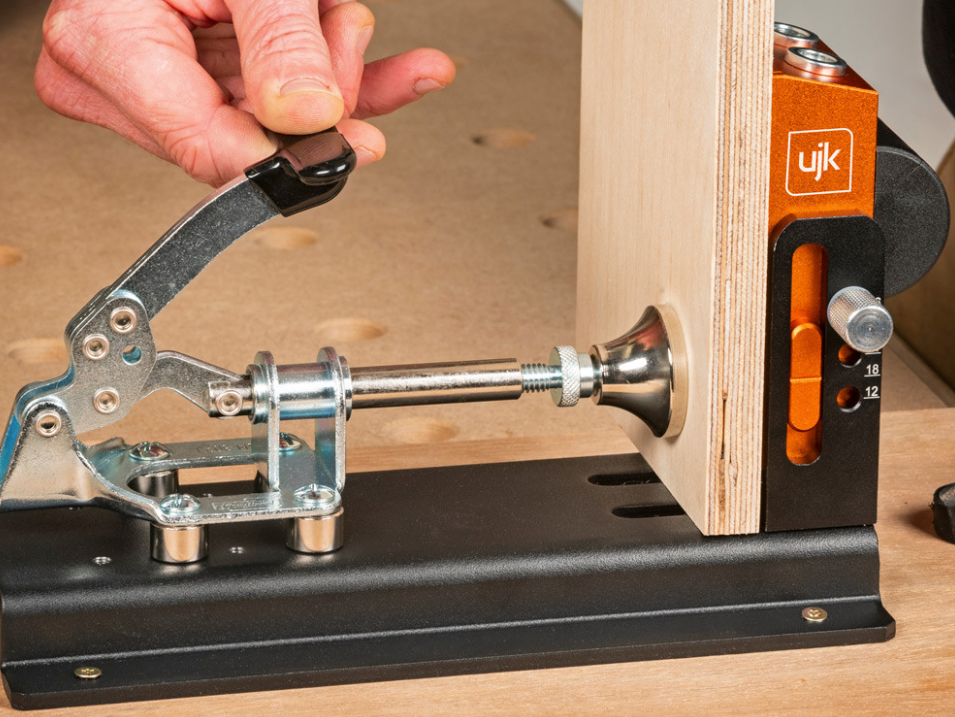
A woodworking jig is a device that holds your workpiece, guides your tool, or both, to produce consistent, repeatable results. The key word is repeatable. A jig takes a setup you've dialed in once and lets you reproduce it reliably across as many pieces as you need.
Worth noting: jigs are sometimes confused with fixtures and templates.
- Fixture — holds work in place (think clamping systems)
- Template — provides a shape to trace or follow
- Jig — controls the relationship between the tool and the workpiece so the outcome stays consistent every time
All three have a place in the shop, but jigs are specifically about repeatable, guided operations.

Why Jigs Matter in the Workshop
If you only make one cut, a jig might be overkill. But the moment you need two or more identical pieces, a jig starts paying for itself. Here's what they bring to your workflow:
- Repeatability — Batch work, production runs, or even cutting four identical table legs all demand consistency that's hard to achieve with layout lines alone.
- Faster setup — Instead of measuring, marking, and double-checking every piece, you set it in the jig and go. Over the course of a project, that time savings adds up fast.
- Better accuracy — You're removing human variables from the equation. A jig doesn't get tired, lose focus, or misread a tape measure at the end of a long day.
- Improved safety — Jigs that hold work securely and guide tools along a controlled path keep your hands in safer positions and reduce the chance of kickback or wandering cuts.
Common Types of Woodworking Jigs
Not every jig serves the same purpose. Here are the types you'll encounter most often, along with when they earn their place in the shop.
Crosscut Jigs
A crosscut jig (typically for a table saw or track saw) ensures square, repeatable cuts across the grain. Table saw crosscut sleds are one of the most common shop-built jigs for good reason. They provide a stable reference for 90-degree cuts and can be modified for other fixed angles. For track saw users, guide squares and crosscut jigs serve the same function with the added benefit of portability.
Taper Jigs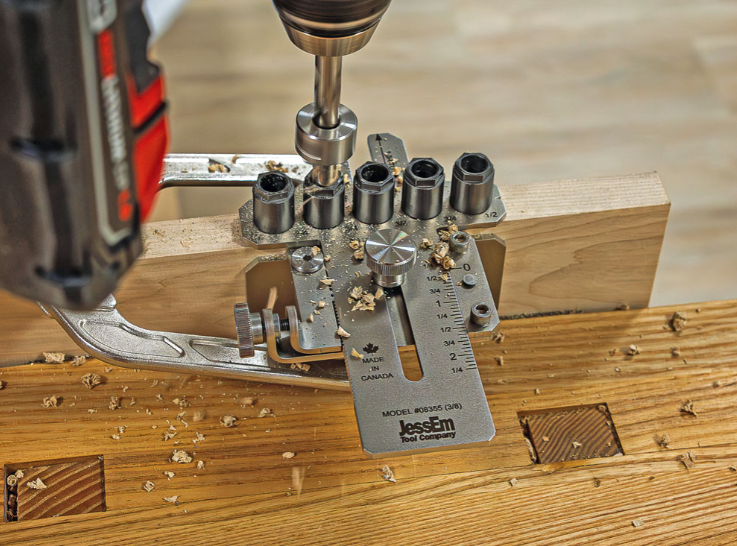
Taper jigs hold stock at a consistent angle relative to the blade, letting you cut uniform tapers for furniture legs, staves, and other angled components. Simple versions use a hinge and stop block, while more refined versions allow micro-adjustments for precise angle control.
Doweling and Drilling Jigs
Accurate hole placement is tedious to do by hand and unforgiving when it's off. Drilling jigs and doweling jigs position your bit in the same spot every time, which is critical for joinery where even small misalignment shows up during assembly.
JessEm Stainless Steel Dowelling Jigs
Box Joint and Dovetail Jigs
Joint-specific jigs handle the precise, repetitive spacing that box joints and dovetails demand. Hand-cut joinery has its place, but when you need 12 identical box joints for a set of drawers, a dedicated jig is the practical choice.
Circle Cutting Jigs
Router-based or bandsaw circle jigs pivot your workpiece around a fixed center point to produce clean, consistent arcs and circles. Simple to build, and they turn what would be a frustrating freehand task into a controlled, repeatable cut.
Track Saw Guide Jigs
For woodworkers using track saw systems, guide jigs and squares provide reliable reference angles for breakdowns, crosscuts, and panel sizing. These jigs bring the precision and repeatability of a fixed setup to a portable cutting system, which is especially valuable for sheet goods work and jobsite cutting.
When to Build vs. Buy a Jig
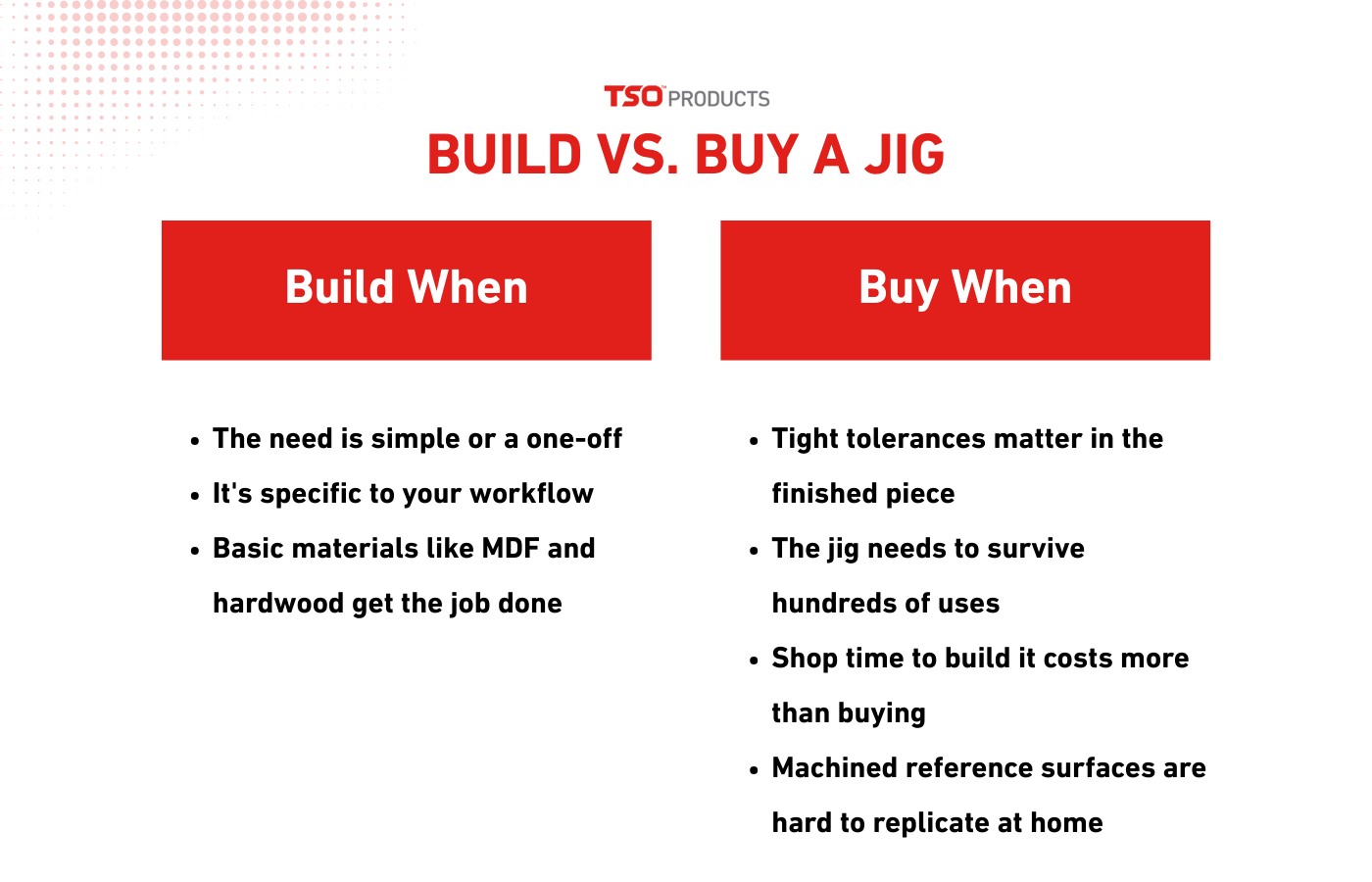
Shop-built jigs make sense when the need is simple, specific to your workflow, or a one-off solution. A basic crosscut sled from MDF and hardwood runners can be built in an afternoon and serve you well for years.
That said, a manufactured jig is often the better call when:
- Tight tolerances matter and small deviations will show in the finished piece
- The jig needs to hold up across hundreds of repeated uses
- The cost of materials and shop time to build one approaches the price of a purpose-built solution
- You need machined reference surfaces that are difficult to replicate in a home shop
The honest answer is that most productive shops use a mix of both.
What Makes a Good Jig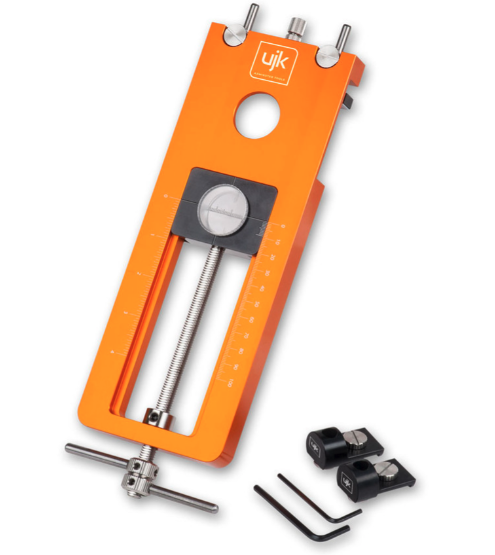
Whether you build or buy, the same core principles apply:
- Rigidity — A jig that flexes under use is a jig that lies to you. Material choice matters. MDF is stable and flat. Aluminum and steel hold tolerances that wood can't match over time.
- Repeatable reference surfaces — If the fence, stop, or guide surface isn't consistent, the jig isn't doing its job. This is the whole point.
- Ease of setup — A jig that takes 10 minutes to dial in for a 30-second cut tends to stay on the shelf. Quick, intuitive setup means you'll actually reach for it.
- Durability — Plywood jigs wear. Edges get dinged. Slots loosen over time. Think about the lifespan you need when deciding how to build or what to buy.
Getting the Most Out of Your Jigs
A jig is only as good as its last calibration check. A few habits that keep your jigs working the way they should:
- Check squareness periodically. This is especially important for shop-built jigs made from wood-based materials that can shift with seasonal humidity changes.
- Label your jigs with setup details like angle, offset, bit size, or whatever parameters you've dialed in. Future you will appreciate it.
- Store jigs properly. Hanging on a wall or in dedicated slots beats stacking them in a pile where reference surfaces get dinged.
- Know when a jig is done. A worn jig that's off by 1/32" is worse than no jig at all, because you'll trust it when you shouldn't.
Build Smarter, Not Harder
Jigs aren't glamorous, but they're one of the most practical tools in any shop. They let you work faster, reduce costly mistakes, and produce the kind of consistency that separates good work from great work.
If you're looking to add precision jigs and guides to your setup, explore our jigs, fixtures, and guides collection for solutions engineered around accuracy and repeatability.
Recent Posts
-
How to Use a Wood Router for Clean, Controlled Cuts
A wood router is one of the most versatile tools in any woodworking shop. It edges, joints, shapes, …6th Mar 2026 -
Woodworking Jigs That Improve Accuracy and Repeatability
Every experienced woodworker reaches a point where freehand work and careful measuring hit a ceiling …3rd Mar 2026 -
Festool Domino Accessories: Why the BigFoot Base System Is Worth a Look
The Festool Domino handles edge mortising well out of the box. Face mortising is a different story. …24th Feb 2026